Real customer project · two power arrangements
Induction-Charging or Wired LED Modules for Custom Lamps?
One customer needed an induction-charging light with a battery for one project and a wired light without a battery for another. Samples helped move the discussions toward confirmed module versions and a continuing supply relationship.
Start by deciding whether your product should store energy in a battery or operate from a connected power supply. In this Vcan customer relationship, both approaches were adopted: a custom induction-charging VC-LS120 version became a repeat-order product, and an external-wire version was also confirmed.
Contact began in 2015. When the customer restarted the LED projects in 2019, the brief covered different light-source shapes, available space, white-light adjustment and two power arrangements. The work developed into an ongoing relationship, with recurring orders of several hundred sets of the custom induction-charging version.
The distinction matters: a battery light charged through a cable and a wired light supplied without a battery are different systems. If your decision is between two ways of charging a battery module, see the separate direct-charge versus induction-charge comparison.
Two projects needed different power arrangements.
Project 1: a battery light with induction charging.
The initial request was for a tube-shaped light with a battery, induction charging and remote control. The customer discussed two tube lengths and an available base size. They also wanted light at the top, rather than only along the sides.
Project 2: an external-wire light without a battery.
For the second project, the customer requested a conventional light-source shape, a fixed cable and an adapter supplying low-voltage power. Remote control and adjustable white light were also part of the discussion. This was a request for continuous external power, rather than another method of charging a battery.
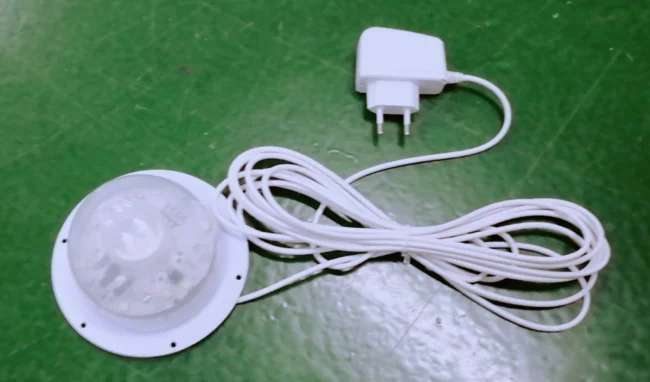
The wired product sheet provides a concrete configuration: a 120 mm LED module with a 5 m cable, EU-plug supply and IR remote control for on/off, colours and modes. This documents the wired arrangement separately from the custom induction-charging VC-LS120.
The early emails also proposed power, voltage and a white-light adjustment range. Those requests should not be treated as final specifications. In particular, the wired sheet's colour and mode controls do not by themselves confirm the originally requested Kelvin range.
The first proposed shape was a starting point.
Vcan proposed evaluating a spotlight alternative for the tube project. The engineering discussion considered the direction of the light, the available base and the practical handling of a long tube. The customer's concern about top illumination made the light pattern an important part of the review.
The correspondence also identified a limitation in the proposed 105 mm platform: the version then discussed did not provide the requested induction arrangement. Changing its base would have involved new tooling. The customer responded by discussing other diameters rather than treating the first dimension as fixed.
For the wired project, a suitable version was not simply available from stock at that point. The customer asked whether a standard sample could be used for initial testing before proceeding with the fixed-wire arrangement. That separated what could be learned from an available sample from what still needed development.
A useful brief therefore explains what the light must do, as well as the shape first imagined. Compare the actual illumination in the intended product; a demonstration outside the housing cannot establish the finished effect. Our guide to LED module brightness and light distribution explains the separate output question.
Samples moved the discussion beyond drawings.
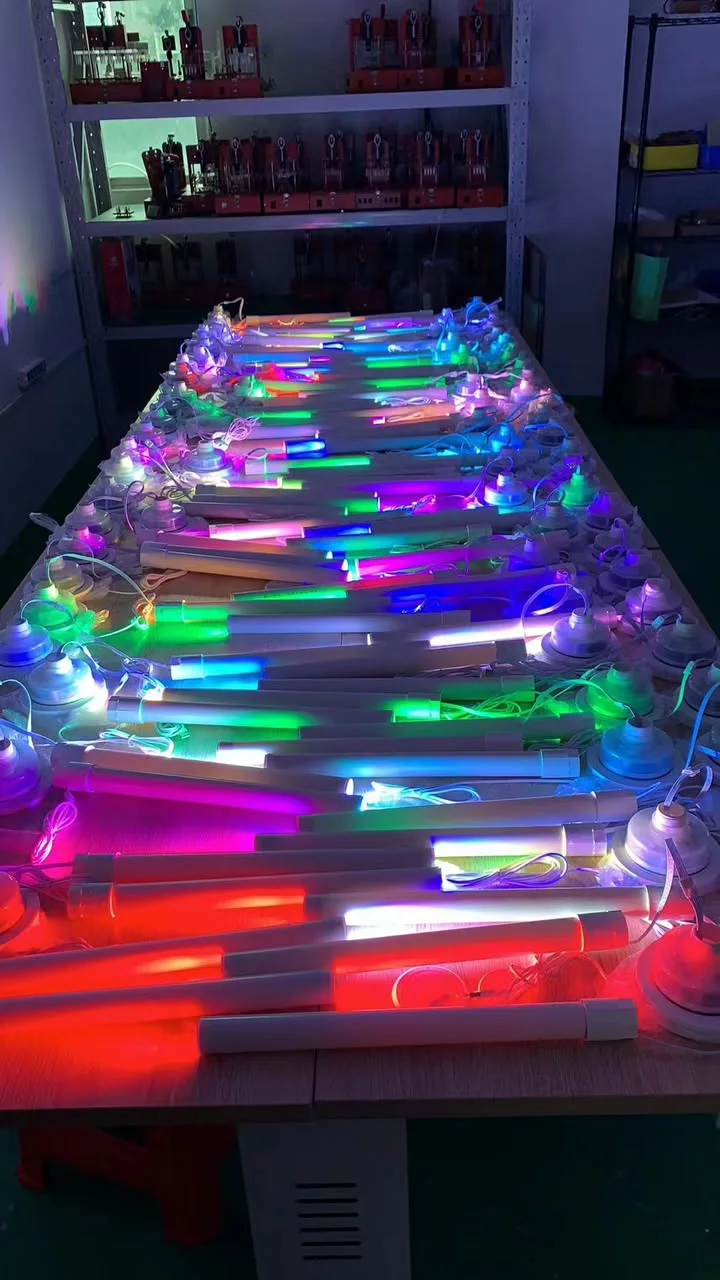
The records include a sample order, shipment and the customer's confirmation that the samples had arrived. The customer then reported that testing was under way and asked further questions about spotlight power, induction charging and a smaller size.
That feedback was a development step, not approval of every original target. The subsequent relationship and repeat purchases are confirmed separately. The available information does not identify the final specification of every sample or establish that the initial tube design was produced unchanged.
For your own project, state the question each sample should answer. A light-pattern trial does not also approve a revised charging system. A housing-fit check does not establish the final battery runtime. Keep those observations with the version tested, using the LED module sample testing checklist.
Keep the rechargeable and wired versions identifiable.
The customer continued ordering the custom induction-charging VC-LS120 in substantial batches. The external-wire version was also confirmed, but the same order quantities are not attributed to it.
For recurring supply, identify each agreed version by its own configuration: housing and mounting details, battery where applicable, power input or charging arrangement, white-light functions, controls and supplied accessories. A shared project history or similar housing is not enough to establish that two modules have the same specification.
The VC-LS120 product page provides a platform reference. This customer-specific induction version should be requested explicitly; it does not change the standard configuration shown for every VC-LS120.
Plan the complete light module
Does your lamp need battery power, a fixed supply, or both versions?
Send a photo or drawing of the product, available module space, required light effect and controls. Describe how each version will be powered and accessed in everyday use, with the sample and production quantities you are considering. Vcan can review a suitable module approach before the configuration is approved.
Induction-charging and wired module questions
Is a wired LED module the same as a rechargeable module with a charging cable?
No. The wired version discussed in this project was specified without a battery and with an external power supply. A rechargeable module stores energy in a battery and uses a charging arrangement to replenish it. Confirm the intended power system before selecting a module.
Can Vcan review both induction-charging and wired versions for a lamp project?
Yes. This customer adopted both approaches for different project requirements. Each version needs its own confirmed specification, including housing fit, power supply or charging equipment, controls and light output. One version's drawing or electrical specification should not be assumed to cover the other.
Does this mean the standard VC-LS120 has induction charging?
This case concerns a customer-specific VC-LS120 induction-charging version. It does not redefine the standard product configuration. Identify the required charging method and custom version when requesting a quotation or reordering.
Can we test a standard module before developing a custom version?
A standard sample can help evaluate the questions it actually represents, such as light distribution or a possible housing fit. A later change to the power system, dimensions or controls still needs review and testing before that revised configuration is approved.
Could the same approach apply to illuminated furniture or other custom light products?
The power-system decision is also relevant to illuminated furniture, planters and other products built around LED modules. Suitability still depends on the particular housing, installation, environment, power arrangement and controls; this case is not a universal compatibility claim.