LED module selection guide
Direct-Charge vs Induction-Charge LED Modules
How to choose the right charging system for illuminated tables, bars, chairs, planters, ice buckets and other rechargeable products.
A direct-charge LED module receives power through a physical cable or charging contact. An induction-charge module receives power from a matching base without an exposed charging connector on the module. Neither system is automatically right for every product: the choice should follow the environment, furniture structure, charging routine and future maintenance needs.
Choose direct charge when simple, accessible and economical charging is the priority. Consider induction charge when a sealed module and contact-free charging are more important. Always compare the complete module, charger, base and remote-control system.
The basic difference
Physical connection or contact-free charging?
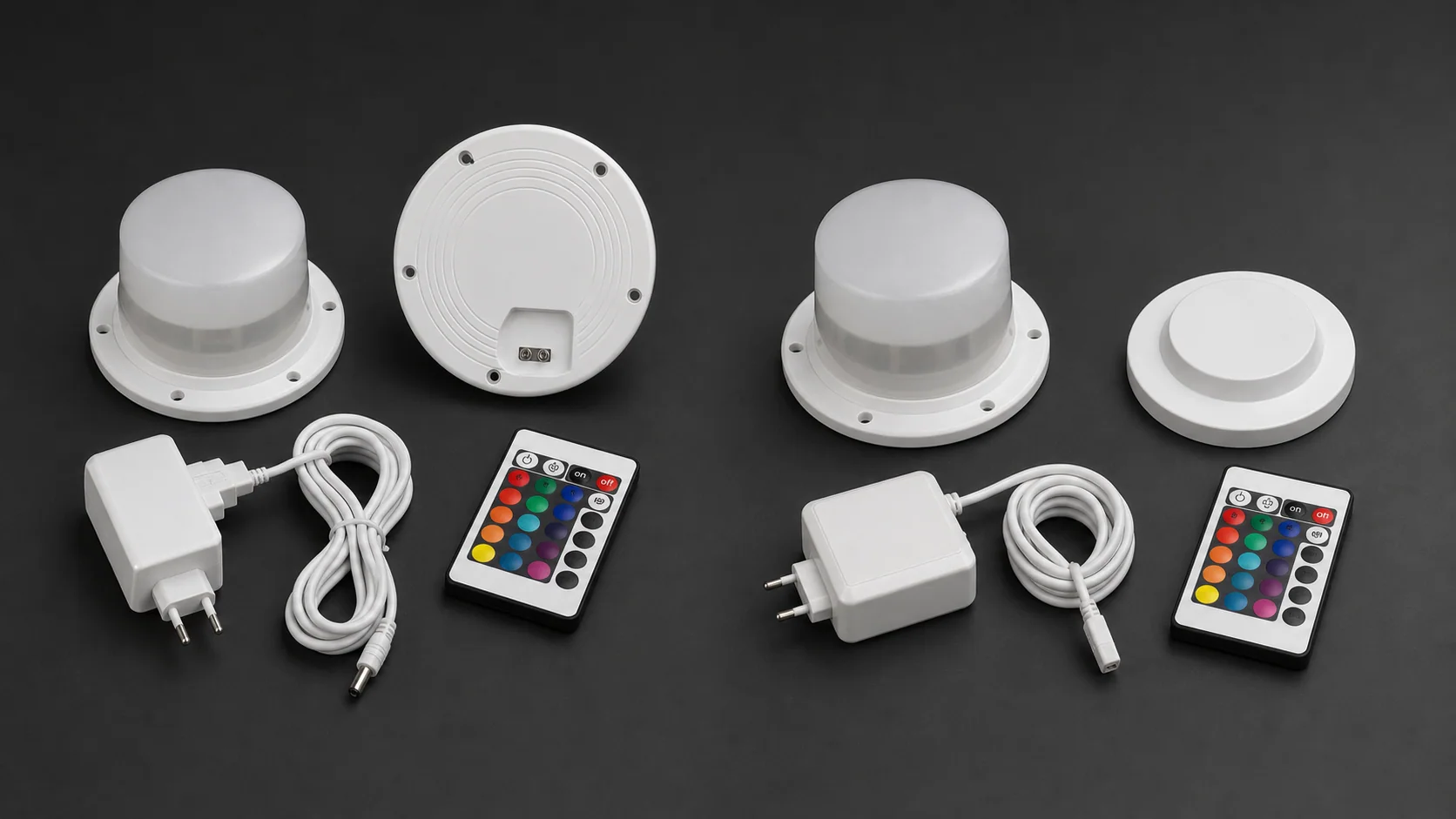
Direct-charge modules connect to their approved charger through a plug, cable or charging socket. This makes the charging path visible and straightforward to check. The charging point, however, needs to remain accessible and must be protected from water, dirt, pulling and repeated handling.
Induction-charge modules use a receiver inside the sealed module and a matching external charging base. There is no exposed charging contact on the module itself. This can support a more sealed product design, but the base, alignment and charging distance become part of the compatibility check.
At a glance
Direct charge and induction charge compared.
| Decision factor | Direct charge | Induction charge |
|---|---|---|
| Charging connection | A cable or charging socket makes physical contact with the module. | A matching base transfers power without an exposed charging connector on the module. |
| Water resistance | IP65 models are available when the charging point and finished installation are correctly protected. | Sealed IP68 model options are available for applications needing stronger protection from water exposure. |
| Daily charging | Connect the correct cable or adapter directly. | Place or align the product with its matching induction charging base. |
| Installation | The charging connector must remain accessible and protected from strain and moisture. | The base position, receiving coil and charging distance must be compatible and correctly aligned. |
| Service | The connector and charger are easy to inspect, but exposed contacts can wear or corrode if poorly protected. | The sealed module has no exposed charging contact, but the correct base is essential for testing and replacement. |
| Typical fit | Indoor furniture, event products and applications where accessible charging is preferred. | Outdoor or frequently cleaned furniture where sealing and contact-free charging are priorities. |
These are practical selection differences, not universal rules. The exact IP rating, size, battery capacity and charging arrangement depend on the selected model and the finished installation.
When direct charge fits
Choose accessible charging for simple operation and service.
Direct charging is often suitable for indoor illuminated furniture, event equipment and products that can be brought to an accessible power point. Staff can see the connection, exchange a matching charger and inspect the socket during routine maintenance.
It can also be practical when purchase cost and straightforward user training are important. For outdoor or washable products, the charging point and the complete furniture assembly still need appropriate protection. Vcan direct-charge module options commonly include IP65 designs, but the final product is only as reliable as its installation and charging-port protection.
Direct-charge reference models include the 85 mm VC-L85 and 120 mm VC-LN120.
When induction charge fits
Choose a sealed module when water exposure is a priority.
Induction charging is useful for illuminated planters, hospitality furniture and other products that may be used outdoors or cleaned frequently. Removing an exposed charging contact from the module reduces one potential path for moisture and corrosion. Vcan offers sealed induction-charge module options rated up to IP68.
The trade-off is that the module must work with the correct charging base. Furniture thickness, base position and alignment can affect charging performance. For an OEM project, these details should be tested with the actual shell before mass production rather than decided from a photograph alone.
Induction-charge reference models include the 85 mm VC-LI85 and 120 mm VC-LI120.
Replacement projects
Do not change charging systems from diameter alone.
Two modules can look similar from the front and still use different charging voltages, connector polarity, charging bases, remote frequencies or control protocols. The flange diameter, furniture opening, screw-hole spacing and available installation depth must also match.
For an existing product, first follow our step-by-step guide to measure and identify a replacement LED module. When compatibility is uncertain, replacing the module, approved charger or base, and remote as one matched set is usually safer than combining unverified parts.
If the original unit is unknown, start with Vcan's replacement LED module compatibility review before changing the charging system.
Selection checklist
Send these details before choosing a charging system.
- Furniture type and indoor or outdoor use
- Expected rain, splashing, cleaning and storage conditions
- How often the product will be charged and who will charge it
- Photos and dimensions of the module opening and installation depth
- Existing charger, charging base and remote-control details
- Required quantity, destination country and OEM requirements
Common questions
Before selecting or replacing a module.
Is induction charging always better than direct charging?
No. Induction charging can improve sealing and remove an exposed charging contact, while direct charging is often simpler and more economical. The better choice depends on water exposure, charging access, installation structure, service needs and budget.
Can I replace a direct-charge module with an induction-charge module?
Only after checking the complete system. The opening size, flange, screw holes, installation depth, charger, remote control and induction base must all be compatible. A similar outside diameter is not enough.
Does an IP68 module make the complete furniture IP68?
No. The rating applies to the tested module. The finished product also depends on the furniture opening, gasket, screws, mounting pressure, orientation and installation quality.
Can the original remote and charger be reused?
Do not assume they are interchangeable. Confirm the charger output, connector or charging base, polarity, remote frequency and control protocol before reuse.
What information should I send to Vcan for selection?
Send photos of the old module, furniture opening, charger and remote; the module diameter, hole spacing and available depth; indoor or outdoor use; expected water exposure; quantity; and destination country.
Product specifications and IP ratings vary by model. Confirm the current drawing, approved accessories and installation conditions before ordering or modifying a finished product.