
Aquarium LED modules · real customer case
LED Modules for Aquarium Lights: Charging Through Glass
The customer needed a waterproof LED module that could stay inside the aquarium, held against the wall and charged from the other side. Vcan adapted the magnetic and induction-charging configuration to meet that need, leading to years of repeat orders.
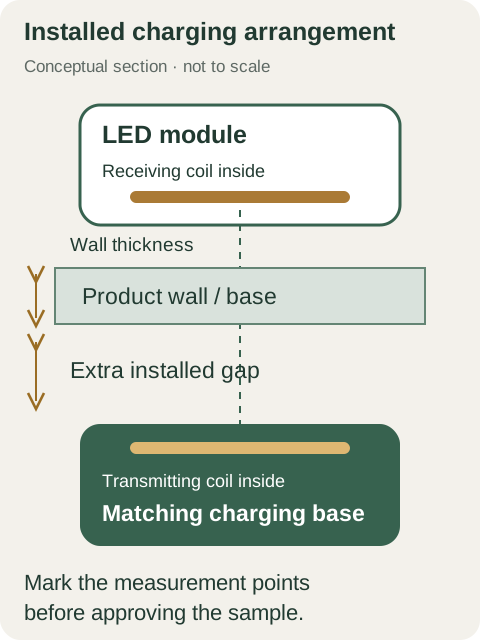
How do you hold an aquarium light against the glass and charge it without plugging a cable into the underwater lamp? This customer needed both functions from the LED module arrangement. Vcan worked through the housing, magnets and charging configuration with the customer, then supplied a solution that met the requirements and became a repeat-order product.
The customer needed the lamp inside and the charging plate outside.
The customer first requested 85 mm waterproof induction-charging samples, stressing that charging had to use a round platform without a plug-in connection to the lamp. After receiving the samples, the customer reported interesting initial test results and went on to evaluate larger modules and modified charging arrangements.
The intended markets included aquariums and portable swimming pools. The stated requirement was to keep the lamp and charger working across glass or plastic from 3 to 10 mm thick. The customer also wanted magnetic attraction to hold the lamp against a side or bottom wall, including resistance to its tendency to float upward.
If you are still choosing between plug-in charging and induction, start with the charging-method comparison. This case follows the development of an arrangement that could hold and charge the lamp through the product wall.
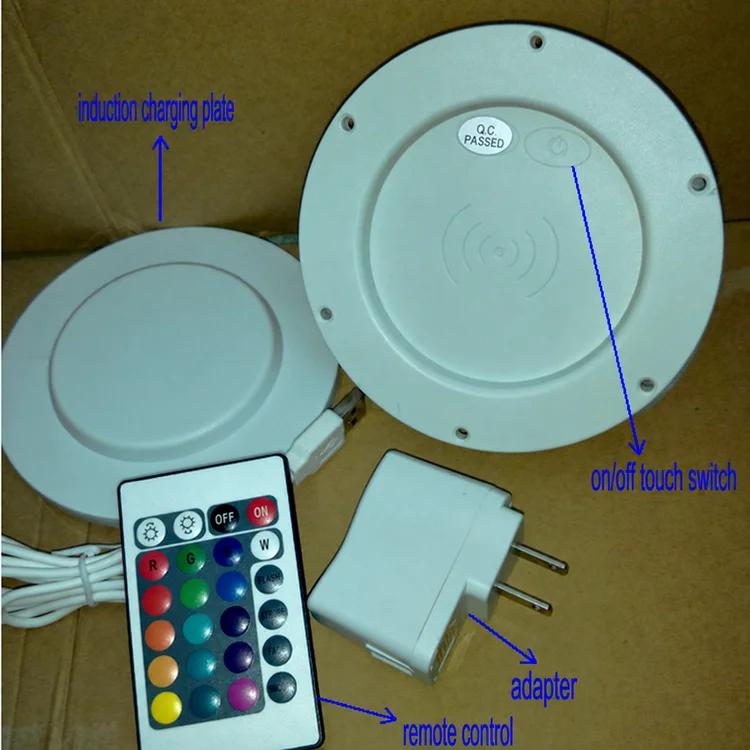
Vcan adapted the housing and charging connections.
During development, Vcan identified that the hollow underside of the sample could leave approximately another centimetre between the lamp and the glass. A flatter bottom was proposed to bring the assembly closer to the wall, alongside changes to the induction electronics. The important distinction was the complete installed spacing, rather than the glass thickness alone.
The power and connection arrangements were revised during the sample work too. After trying an 85 mm version with a higher-voltage supply, the customer preferred a 5 V USB arrangement with a separate micro-USB connection. The larger version was discussed with a different power supply and round connector. One version's adapter and gap therefore could not simply be assigned to the other.
After the sample revisions, the configuration met the customer’s requirements and entered ongoing supply. For a new product, the useful lesson is to confirm the complete installed combination: the successful customer configuration does not assign the same charging distance, input or connector to every Vcan model.
The magnets also had to hold the aquarium lamp in place.
This aquarium project asked the magnets to do more than locate a lamp on a charging plate: they were also intended to retain the lamp against the wall. That was a customer-specific mechanical requirement, separate from the charging-alignment role of magnets in Vcan's standard VC-LI85 and VC-LI120 arrangements.
During development, the customer reported heat around the magnets in an extended charging test. Magnet removal and a different layout were discussed as part of the revisions. The project subsequently reached a configuration that met the customer’s requirements and led to ongoing supply. The development feedback shows why holding force and charging behaviour needed to be considered together.
For your project, define the required holding position and charging conditions separately, and have the complete arrangement reviewed. A higher-current adapter rating or a stronger magnet is not evidence that a reported heating problem has been resolved. If unusual heating appears during a sample test, stop and refer the actual configuration to Vcan before continuing.
The solution led to a 50-set order and years of repeat business.
The resulting configuration met the customer’s requirements for this project. The customer subsequently ordered 50 sets and has continued placing repeat orders over the years.
The practical result was a module arrangement that combined retention against the aquarium wall with induction charging through it. For another aquarium or illuminated product, Vcan can review the wall material, thickness, lamp housing and required position together, then confirm the appropriate configuration through samples.
Agree what the distance is measured between.
A statement such as “the base is 5 mm thick” describes one dimension. A complete section should also show where the module sits, where the charging plate sits and any clearance between those parts and the wall. Recessed surfaces or feet may introduce spacing that is absent from the wall-thickness measurement.
Distinguish the outside surfaces you can measure from the transmitting and receiving coils inside the assemblies. Ask Vcan which reference points apply to the proposed version, and mark them on the drawing. Avoid combining a distance taken from one drawing with a measurement using different reference points.
Include the wall material, coatings, inserts and nearby metal components in the brief. The general engineering principle is that received charging power depends on coil distance and alignment as well as the power system; see Analog Devices' explanation of wireless battery charging. That reference does not supply a rating for a Vcan module.
Production videos: magnetic engagement and the module assemblies
These Vcan production videos show the strong-magnet induction-charging configuration and its physical engagement. This custom arrangement was developed to hold the module and charging plate on opposite sides of glass or a similar product wall while charging. The clips do not show a measured intervening wall or establish a supported thickness.
For your own product, confirm both retention and charging through the actual wall material and installed spacing. This custom holding function should not be assumed for every standard module.
Test with the real base, not only the bare module.
Use the intended housing sample or a representative section with the agreed material and spacing. Keep the module, charging base, power supply and positioning arrangement identifiable throughout the trial.
- Record the module version, charging-base reference and drawing revision.
- Measure the agreed gap at the specified reference points after assembly.
- Observe how the product locates on its charging base in normal use.
- Follow the supplied charging procedure and record the indicators, charging completion and elapsed time.
- Check subsequent operation at the agreed lighting setting, and record any change needed before approval.
Agree with Vcan which additional checks are needed if manufacturing tolerances or normal placement change the spacing. Use the LED module sample testing checklist for the wider fit, light, control and runtime review. If the battery or charging circuit also changes, review the complete charging configuration.
Separate electronics evaluation from sealed-assembly testing. In this project, some development samples were prepared so their electronics could be accessed; those samples were not equivalent to a sealed unit for a water test. The customer also requested CE and RoHS information. Check the documents applicable to the agreed configuration rather than treating a sample's operation as proof of its waterproof rating or finished-product compliance.
Aquarium LED module questions
Can an induction-charging LED module charge through glass or plastic?
Yes, with a suitable module and matching charging arrangement. In this aquarium project, the customer requested charging across glass or plastic walls from 3 to 10 mm thick. Vcan met the customer’s requirements and the customer has continued to reorder. The stated range belongs to this project brief, rather than a thickness rating for every module. Confirm the material, installed spacing, module and matching charging base, then test the intended assembly.
Is wall thickness the same as charging distance?
Not necessarily. Wall thickness is one part of the installed arrangement. Recesses, clearance and coil locations inside the module and charging base also need to be understood. State which surfaces or reference points a quoted distance is measured between.
Does a stronger magnet guarantee charging across a larger gap?
No. This customer needed attraction to hold a lamp against an aquarium wall, as well as induction charging across that wall. Those were separate mechanical and electrical requirements. The project reached a configuration that met the customer’s requirements and led to repeat orders, but the development work considered charging behaviour as well as magnetic retention.
Can I use the charging distance discussed for a different-size module?
Do not transfer it without confirmation. In the historic development brief discussed here, the customer made separate requests for two module sizes. Confirm the drawing, charging base and approved test conditions for the version you plan to use.
Is a charging indicator enough to approve the installed sample?
An indicator is one observation. Also verify completion of charging, the agreed charging time and subsequent operation using the actual installed arrangement. Follow the instructions and test conditions for the supplied configuration.
Can a light operate only while it is on the induction platform?
The customer later requested a battery-free version that would light only while receiving power from the platform. That is a separate wireless-power configuration, rather than battery charging. It needs its own engineering review and sample confirmation; it should not be assumed available from an unchanged rechargeable module.
Review the module inside your product
Developing an aquarium light that charges through the wall?
Send a section drawing or clear photos showing the lamp inside the aquarium and the proposed charging-plate position outside it. Include wall material and thickness, module space, holding position, required light functions and planned quantity. Vcan can review a suitable LED module configuration and what the sample needs to demonstrate.