
Silicone lamp development · Real custom project
LED Modules for Silicone Lamps: Selection and an Even Glow
Select the internal LED module around the silicone lamp you are making: its shape, available space, intended light effect and charging needs. Here is how Vcan approaches that selection, with application examples and a real 120 mm custom development project.
Vcan's full LED module range can be used in silicone lamp designs. Select the model to suit the customer's housing space, light effect, charging method and control requirements. The small-module applications and 120 mm custom project below illustrate different choices within that range. In the custom project, the customer was satisfied with the revised top-and-side illumination and the requested USB-C change.
Which LED module suits your silicone lamp?
A rechargeable LED module provides the light inside the silicone body. Start with the shape you want to illuminate and the space available inside it, then test the selected module in your actual shell.
For example, Vcan's 45, 60, 75 and 85 mm modules are used in silicone rabbit lamps, egg-shaped night lights, small light balls, mushroom lamps, alien-shaped lights, pumpkin lights and small table lamps. These are familiar small-product applications. Larger modules can also be selected for silicone designs when their dimensions and functions suit the project. A shape alone does not determine a single module size.
For a compact body, begin with the 45, 60 and 75 mm LED module size guide and compare the available LED modules. A larger body or a more demanding light distribution may call for a different starting point, as the following project shows.
Solving uneven light with LEDs facing up and around the sides
A customer developing a silicone lamp first gave positive feedback on sample battery performance, charging and ease of operation. Once the light was evaluated inside the lamp, they reported that the body was not illuminated evenly. They asked about light directed sideways as well as upwards.
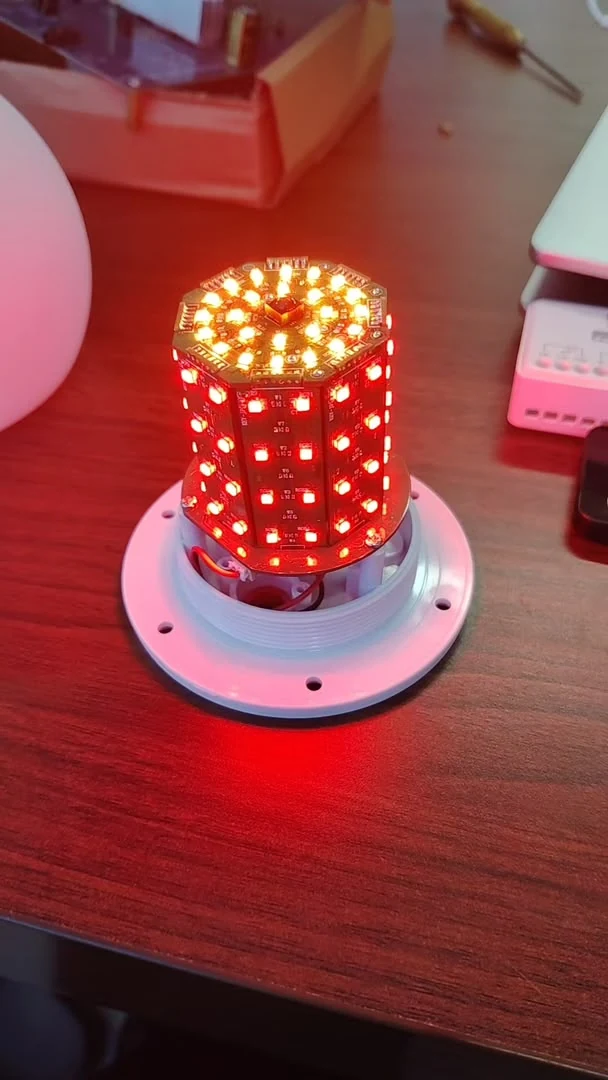
The custom development used an existing 120 mm base. The revised assembly has LEDs on its top and around its vertical sides, as the workshop photo shows. This arrangement sends light upwards and outwards around the body, addressing the need for surrounding illumination.
Vcan's follow-up with the customer confirmed that the revised light effect was satisfactory. This gives the project a practical outcome: the existing base was retained as the platform, while the LED arrangement was adapted to the lamp's lighting requirement.
The important distinction is where the light is directed. A brighter upward-facing source is not automatically the answer when the sides need more illumination. Review the layout in the assembled shell. The guide to assessing LED brightness inside a lamp explains the wider light-output checks.
See the light source and the diffused effect
These real workshop clips show the exposed top-and-side LED assembly and its light through a translucent test sleeve. They help explain the layout and visual effect. The sleeve is a demonstration housing, rather than a photograph of the customer's finished silicone product.
Use the clips as visual references for the revised layout. Check the effect in your own silicone body, where the material's colour, thickness and shape also influence the visible glow.
The requested USB-C change was completed
The customer also wanted the USB-A connection changed to USB-C. This was completed in the agreed charging setup, and the customer was satisfied with that revision too.
Specify the required connection together with the charging equipment when discussing a new module. Vcan can review it as part of the complete configuration. For a comparison of charging approaches, see the direct-charge and induction-charge guide.
From a paid custom sample to agreed production terms
The customer accepted custom sampling and paid a fee higher than that for an ordinary sample. This was a project-specific sample with a revised light arrangement and charging connection.
| Project item | Confirmed detail |
|---|---|
| Existing base | 120 mm module base used for the custom development |
| Lighting revision | LEDs on the top and around the sides for upward and surrounding illumination |
| Charging revision | Requested USB-A connection changed to USB-C in the agreed charging setup |
| Customer feedback | Satisfied with the revised light effect and USB-C change |
| Custom sampling | Accepted and paid; fee higher than a standard sample |
| Production terms | MOQ 300 pieces after sample approval; lead time around three weeks |
For this configuration, the production minimum was 300 pieces after sample approval, with a lead time of around three weeks. These are the terms discussed for this project; confirm the current quotation and schedule for a new design.
Before moving into production, keep the approved light effect, module configuration and charging setup together in the sample record. Our sample-testing checklist can support that review.
Choose the internal light around your silicone lamp
Consider the full module range against your design requirements. A small silicone egg lamp and a taller decorative body can need quite different internal light arrangements. Begin with three practical details:
- Show the shape. A photo, sketch or drawing lets us see what should glow, including any narrow or projecting parts.
- Give an approximate module diameter. If you know the available space, share it. You can start the discussion without knowing a Vcan model number.
- Describe the light, charging and controls. Tell us the intended colour, where the body looks dim, how you want to charge the lamp and how the user should operate it.
Those details help us discuss a standard starting module or a custom sample. The OEM LED module service covers project review and configuration development. For a separate example of physical prototyping before tooling, see the custom stone-shaped lamp case.
Questions about LED inserts for silicone lamps
Are silicone lamps limited to small LED modules?
Vcan's full LED module range can be used in silicone lamp designs. Choose the model according to the housing space, desired light effect, charging method and controls. The 45, 60, 75 and 85 mm applications and the 120 mm custom project in this guide are examples, not a complete list of suitable models. Confirm the fit and operation in your own lamp sample.
How was uneven lighting in this silicone lamp project solved?
The revised assembly placed LEDs on the top and around the sides, allowing light to travel upwards and outwards around the housing. Vcan's project follow-up confirms that the customer was satisfied with the revised light effect. Test the layout in your own shell before approval.
Was the USB-C requirement completed?
Yes. For this project, the requested USB-A connection was changed to USB-C in the agreed charging setup, and the customer was satisfied. The connection and charging equipment should be specified together for a new project.
What were the custom sample, MOQ and lead-time terms?
The customer accepted a custom sample fee higher than that for a standard sample. Production terms for this configuration were a minimum of 300 pieces after sample approval and a lead time of around three weeks. Confirm the quotation and schedule for your project; these are not universal terms for all Vcan modules.
Show us the silicone lamp you are developing
Send a picture or sketch and an approximate light-unit diameter if you know it. If you already have a sample, show which parts of the body need a more even glow. We can start from your product and discuss the next useful sample.